







2026年5月
When theatre in Malaysia returned after the COVID-19 lockdowns, it did not simply resume; it surged. Venues filled rapidly, overlapping runs became common, and for a brief moment, the density of productions suggested a field in robust recovery.
Yet this apparent resurgence raises a more difficult question: Is this growth sustainable, or is it a symptom of systemic strain?
Between 2023 and 2025, 99 productions were submitted to the BOH Cameronian Arts Awards, the country’s primary benchmark for the performing arts. In 2025 alone, the count reached 36, alongside a separate cluster of musical theatre works competing for the same limited stage time and audience attention. While these figures suggest activity, they do not necessarily indicate stability. Without a corresponding expansion in venues or infrastructure, this high output risks masking deeper structural fragilities.
Crucially, this surge remains geographically concentrated. The majority of productions are staged within the Klang Valley, comprising Kuala Lumpur, Putrajaya, and much of Selangor, which functions as both production hub and primary audience base. Rather than reflecting a nationally distributed ecology, Malaysian theatre currently operates within a dense but localized circuit, one that risks becoming self-referential despite its creative diversity.
Acceleration Without Expansion
The post-lockdown period has produced a paradox: more productions are being staged, yet the conditions underpinning them remain largely unchanged. Limited venue availability, inconsistent funding cycles, and short performance runs continue to define the ecosystem.
Many productions close after only a few days. For audiences, the result is not abundance but saturation. Multiple shows compete within narrow timeframes, often without sufficient marketing reach or audience development. For practitioners, the consequences are more severe. Rehearsal periods are compressed, commitments overlap, and there is an increasing reliance on project-based survival.
This acceleration is not purely aesthetic; it is infrastructural. Funding bodies such as the Ministry of Tourism, Arts and Culture (MOTAC), CENDANA (the Cultural Economy Development Agency), and Yayasan Hasanah’s Arts for All Seasons (ArtsFAS) typically disburse grants later in the year. This creates a bottleneck in which productions cluster toward the final months. The calendar is shaped less by artistic pacing than by administrative timelines.
In this context, what appears to be creative momentum begins to resemble a system calibrated for output rather than sustainability.
Aesthetics as Survival Strategy
The Malaysian stage today is a volatile mix of forms that is messy, inventive, and increasingly shaped by pressure rather than pure intent. What is often framed as aesthetic experimentation is, in many cases, a response to constraint. There is a visible push to “decolonize” the classics by fusing contemporary sensibilities with traditional forms such as bangsawan, a form of operatic folk theatre, mek mulung, an ancient dance-drama tradition from Kedah, and randai, a Minangkabau performance form combining dance/movement, martial arts, music, and storytelling. This is not solely an artistic impulse; it is also a strategy for survival within limited means.
This pressure has produced a noticeable shift in form. Works such as Teater Bangsawan Indie: Puteri Gunung Ledang (2023) and Jebat (2023) move away from the formal density and spectacle of traditional theatre toward leaner, more immediate staging. These are not merely stylistic choices but recalibrations shaped by time, budget, and resource constraints.
At its most compelling, this shift produces genuinely transformative work. Randai Macbeth (2024), for instance, does more than adapt Shakespeare. It reconstructs the play through the performative logic of randai, a Minangkabau tradition rooted in circular staging, rhythmic movement, music, and collective narration. Here, the text is not simply translated but re-authored through a local dramaturgical system. Its success, both critically and institutionally, suggests that localization, when pursued beyond surface aesthetics, can generate work that resonates with structural as well as cultural specificity.
This may appear to signal a departure from the “safe” choices that have long defined the scene. Yet the reality is more uneven. The recent wave of adaptations such as The Seagull (2024), Three Sisters (2024), Perhiasan Kaca / The Glass Menagerie (2024), The Bee (2024), and Dream of the Red Chamber (2025) reveals a more complicated split. On one level, it is encouraging to see local artists engaging with the global canon. On another, many of these works remain structurally and culturally tethered to their source material, with limited attempts to meaningfully localize or recontextualize them within a Malaysian or Nusantara framework. In such cases, adaptation begins to resemble replication under new conditions rather than reinterpretation. The reliance on recognizable titles feels less exploratory than strategic, functioning as an attempt to stabilize an unstable market through familiarity. It raises an uncomfortable question: are we expanding our theatrical language, or defaulting to inherited texts because original work feels too risky to sustain?
This tension sits at the core of the current aesthetic landscape. If hybridity gains traction because it works, because it is fundable, legible, and award-friendly, does it remain an intervention, or does it harden into formula? At what point does decolonization risk becoming a new orthodoxy governed by its own expectations of form and success?
Post-Lockdown Interiorities
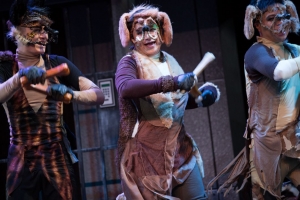
Alongside formal experimentation, there has been a noticeable thematic convergence. A significant number of recent works, including Mama Looking For Her Cat (2023), Come Home and Eat (2023), Bilik Ahmad Berdaki (2025), and Anak-Anak Malik (2025), center on domestic spaces and interpersonal tension. These plays are not explicitly about the pandemic, yet they bear its psychological imprint. The home is no longer a neutral setting. It becomes a site of compression where unresolved relationships intensify under conditions of proximity.
This aligns with broader global patterns in post-lockdown performance, where narratives of confinement, isolation, and relational strain have resurfaced across multiple contexts. In Malaysia, however, these themes intersect with existing familial and cultural frameworks, producing works that feel both specific and widely legible.
At the same time, a parallel shift is emerging. Productions such as The Amok of Mat Solo (2023), Animal Farm (2025), and TEWAS: No Light at the End of the Tunnel (2025) mark a return to political allegory and protest. If earlier works internalized the pressures of isolation, these productions externalize them by redirecting attention toward systemic critique.
Together, these strands suggest a field oscillating between introspection and confrontation.
Fragmented Audiences, Partial Integration
Malaysia’s multilingual theatre landscape, spanning Malay, English, Mandarin, and Tamil, has long been framed as a marker of diversity. In practice, however, it often reflects segmentation rather than integration.
Audiences tend to circulate within linguistic and cultural silos, even when surtitles are available. The result is not a shared national theatre culture but parallel ecosystems with limited overlap.
Recent productions such as Fragments of Tuah (2025) and Murder At The Jet (2025) indicate a possible shift. These works attempt to construct theatrical languages that move across, rather than remain confined within, these divisions. While still emergent, they point toward the possibility of a more integrated audience base, one that does not erase difference but engages it structurally.
The Labor Behind the Stage
If the current moment reveals anything with clarity, it is the growing visibility of labor within theatre-making. Persiapan Seorang Aktor (2024), widely recognized in the awards circuit, exemplifies this shift.
Rather than presenting performance as a finished product, it foregrounds the process itself. The discipline, repetition, and emotional strain embedded in actor training are made visible. By intertwining personal relationships with the demands of mastering performance techniques, the work exposes a central contradiction. The pursuit of artistic excellence often unfolds within precarious and unsustainable conditions.
This reframing challenges dominant evaluative criteria. If theatre continues to be judged primarily by its final presentation, the structural costs of producing that work remain obscured. A more rigorous critical framework must account not only for aesthetic outcomes but also for the conditions under which they are produced.
Beyond Output
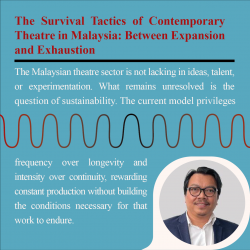
The Malaysian theatre sector is not lacking in ideas, talent, or experimentation. What remains unresolved is the question of sustainability. The current model privileges frequency over longevity and intensity over continuity, rewarding constant production without building the conditions necessary for that work to endure. Without corresponding investments in infrastructure, regional distribution, and long-term funding strategies, increased production volume risks accelerating practitioner burnout rather than strengthening the field. What appears, on the surface, as vitality begins to reveal itself as strain. It is an ecosystem stretched thin and sustained more by urgency than by stability.
To move forward, the terms of success require recalibration. Vitality cannot continue to be measured solely through the number of productions staged within a given year. Greater emphasis must be placed on extended runs that allow audiences to discover and engage with work over time, rather than within compressed windows of visibility. Resource distribution must expand beyond the Klang Valley, disrupting the current concentration of opportunities and enabling a more genuinely national theatre ecology. Equally crucial is the need to realign production timelines with artistic processes rather than administrative cycles, allowing work to develop at a pace determined by creative necessity rather than funding deadlines. These shifts would not diminish output. They would make it sustainable, enabling artists to build, refine, and sustain their practice over time.
The past three years have marked a period of undeniable activity within Malaysian theatre. But activity alone does not constitute stability. What is emerging is a field in transition, balancing expansion against exhaustion. The momentum is visible, but the structures supporting it remain fragile.
Malaysian theatre has the potential to assert a distinct voice globally, grounded in its ability to navigate between languages, traditions, and contemporary pressures. The work is already there. The question is whether the system can evolve fast enough to sustain it, before exhaustion becomes its defining condition.
本網站內一切內容之版權均屬國際演藝評論家協會(香港分會)及原作者所有,未經本會及/或原作者書面同意,不得轉載。