








2026年3月
Since 2025, it has been said a lot: local theater is alive, this is a golden age, a renaissance! What a great time for Philippine theater.
We can, after all, tick off the usual boxes: sheer number of productions, a bigger number of local mainstream theater companies, independent collectives, and solo acts. Sold-out shows, plus re-runs and repeats and adaptations that cut across forms. New and old theater collectives and performance projects getting funding, traveling the world. But ticking off boxes is one thing, while changing systems, doing better by theater workers, and cradling spaces for critique and diverse creativities, is another. A checklist is not what a productive, sustainable, and innovative theater sector makes.
In 2026, the Philippines will hold the first Manila International Performing Arts Market (MIPAM) which, whether it likes it or not, takes from what started as the Tokyo Performing Arts Market (TPAM) established in 1995, but which evolved into the Yokohama International Performing Arts Meeting (YPAM), with a Southeast Asian iteration through the Bangkok International Performing Arts Meeting (BIPAM).
Back to basics
Recently, a former student now working in theater productions, referenced an article defending the high cost of theater tickets and asked: Yes, there is a niche audience that can afford theater tickets, but what about theater workers who are paid less than the cheapest tickets to the productions they are working for?
Her question was rhetorical. Mine isn’t. If the members of a production cannot afford to watch the play they are working on, what does that say about the math we use to compute for wage? Because niche audiences will pay for tickets — we see this across local and foreign productions with prohibitive ticket prices. It is impossible that there is no math that will allow theater workers to earn a living wage.
This is not to say that no one has sought to answer this question before. It is to say that the conversation usually ends with lamentations about the cultural systems and how there is very little we can do. Venues are expensive, bigger theater stars and creatives need to be paid well, and in this list of many expenses, what is sacrificed is the wage of the theater workers on the lower rungs of the employment ladder.
The system is broken. And it was front and center during the Covid-19 lockdowns, when the majority of theater workers were revealed to have no savings, no social security, no medical benefits, no unions or organizations that function as such, despite decades of work in the theater sector. Expectedly, the wealthier in the sector mounted fundraisers and spent from their own pockets. But when generosity ran out, it became only a matter of waiting for the lockdowns to be lifted and for the crisis to be deemed over.
In reality, it remained just that. A crisis. One that is at the core of this sector, one that is its lifeblood.
The system and the text
Just as it is easy to tick off a set of boxes so that one might claim to be in a theater renaissance, so it is easy to imagine that the precarity of theater workers has little to do with the plays and performances we are staging in the Philippines. This surfaces a shallow understanding of the role of capital in the making of theater: how it works and dictates the kinds of creativities we can engage in, the kinds of products we offer a public, and even how we define that public.
When, for example, it is decided that adaptations of movies for the stage are better investments than doing new original work, at the heart of that decision is the premise of profitability: old material will have a cult following and have its marketing cut out for them (various production companies for Ang Himala, 2018, 2024; Ideas First Live!’s About Us But Not About Us, 2026; Newport World Resorts, Viva Communications Inc., and The Philippine STAR’s Bagets, 2026). When whole productions are built from a list of famous songs, that is a decision to feed off an audience ready to spend on nostalgia (Full House Theater Company’s Ang Huling El Bimbo, 2018, 2019, 2023; Buruguduystunstugudunstuy, 2024; Nine Works’ Theatricals’ Liwanag sa Dilim, 2025).
The staging of foreign productions, both by local and foreign companies (Theater Group Asia’s Into The Woods, 2025, and The Chorus Line, 2026; GMG Productions’ most recent production Jesus Christ Superstar, 2026 after sold-out shows for Les Miserables, 2026 and Hamilton, 2023; Sandbox Collective’s Spring Awakening, 2026; Nine Works’ Theatricals’ The Bodyguard, 2025), feeds off the colonial mentality of a Filipino audience and all that this implies. Here is an audience for whom foreign theater is proof of their social status; here is an audience for whom the foreign is already framed to be so valuable as to deserve yet another re-staging in the already limited space of the local.

Jukebox musicals as a mode of production that feeds off a niche audience readiness to spend on nostalgia. From left to right: Ang Huling El Bimbo, 2018, 2019, 2023; Buruguduystunstugudunstuy, 2024; Liwanag sa Dilim, 2025.
This colonial mentality leaks into many other practices that inform contemporary theater and performance in the Philippines. Say, the return of the proverbial scholar or worker from the foreign, they who seem to rarely have qualms about taking on the role of, or deliberately work towards becoming, central characters in the local cultural landscape. This privileging is so rarely discussed, yet with no recent history and experience in this context, it is clear that this main character energy warrants more complex discussions. At the very least, it needs to be said that there is disingenuity in claiming to be part of a decolonization project, while at the same time benefiting from the neo-colonial gaze.
It is because of this that foreign funding as a mode of production needs to be unpacked, not as a simple opportunity to get projects off the ground, but as a negotiation of capital. How does a foreign entity build its own cultural capital with the use of local texts and contexts? What kind of gaze does it use to decide which projects to fund? How are the creativities from and of the local affected by this engagement? How does the interest in identity-centric projects speak of both the gaze of the foreign, and the performance of the local? Who does this mode of production erase?
And when we decide to deny ourselves these discussions on capital and modes of production, who does that theater serve?
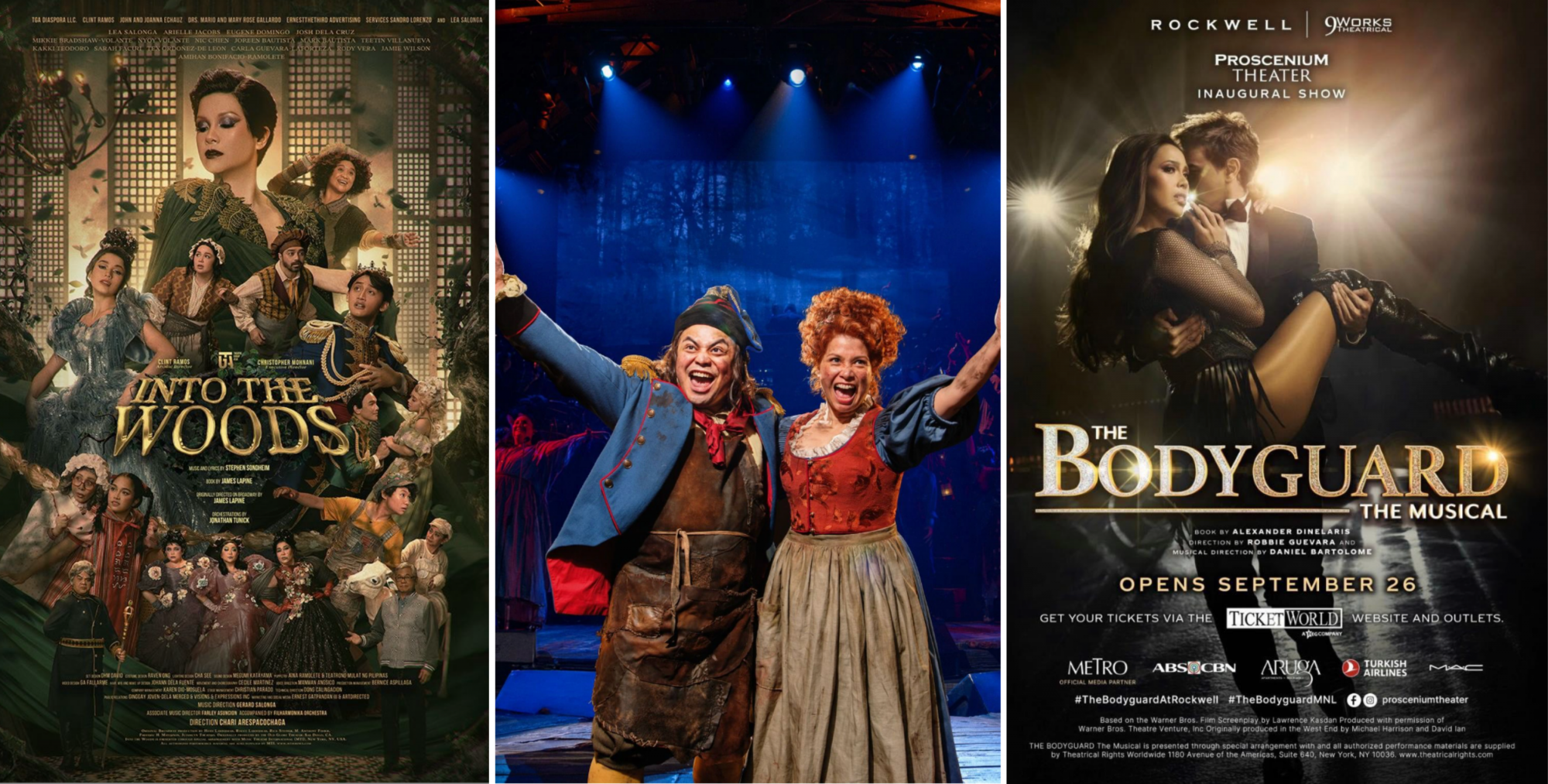
Large scale foreign productions on overdrive, a mode of production that feeds off colonial mentality in the name of sold-out shows. From left to right: Theater Group Asia’s Into the Woods, 2025; Red Concepcion and Lea Salonga, two of four Filipino actors in GMG Productions’ Les Miserables, 2025 (image from GMG’s Facebook Page); Nine Works Theatrical’s The Bodyguard The Musical, 2025.
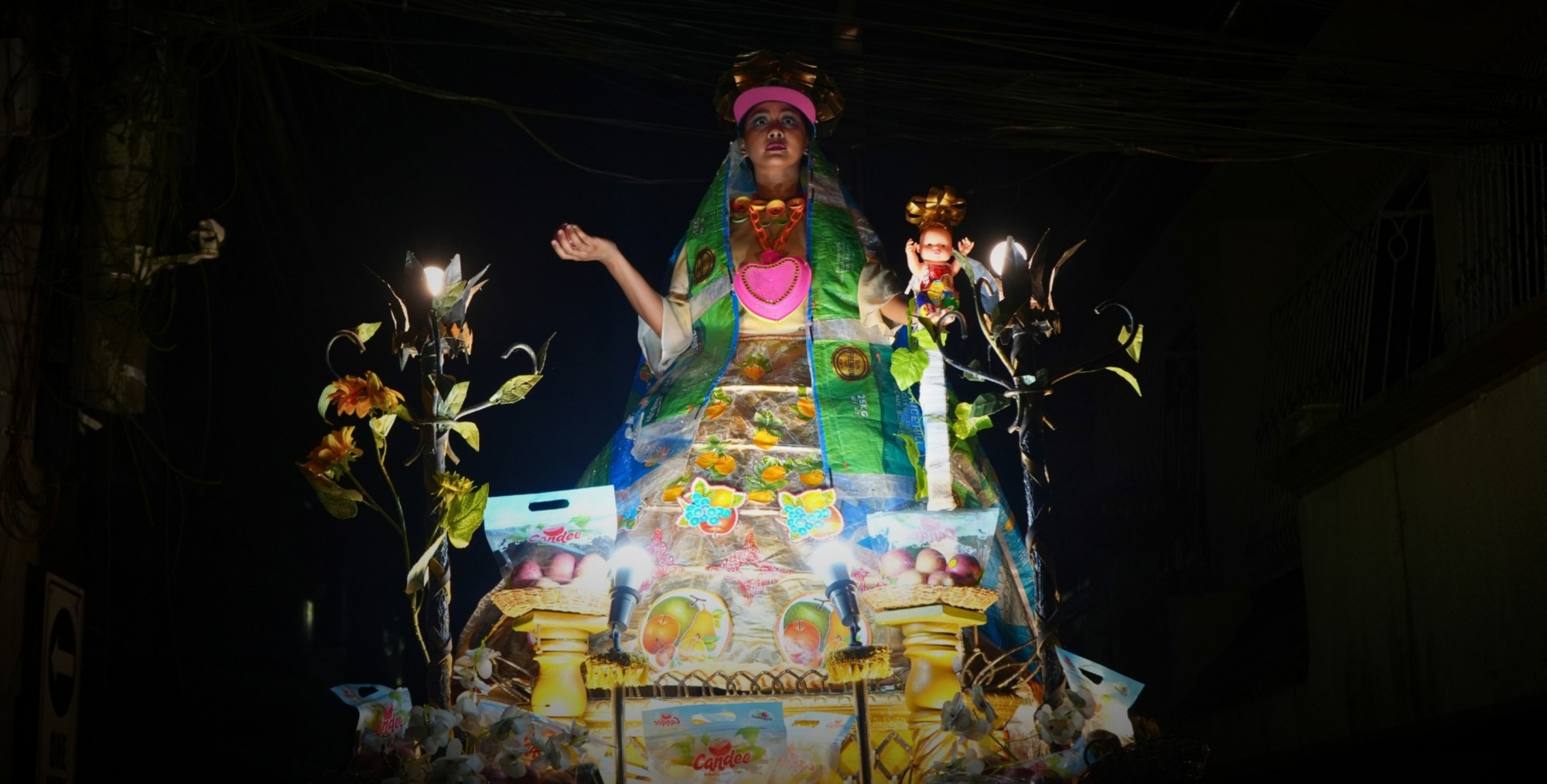
Foreign funding as a mode of production — the urgent need to unpack the foreign appetite for and colonial framing of the local as exotic, and how that feeds into (or eats up) local creativities. Image from Ea Torrado’s “Brown Madonna” project for Goethe Institut’s Performance Ecologies. Photo from the Goethe-Institut Philippinen Facebook Page, publicly available, posted on February 28, 2026.
A search for the present progressives
A week after the U.S.-Israel attack on Iran in early March 2026, which spiraled to attacks on the United Arab Emirates (UAE) soon after, not a few theater workers noted that venue prices for live events were already going up. Since then, the Philippine government has declared a State of National Energy Emergency.
No, we are not locked down in the way we were during the Covid-19 pandemic. But as with the pandemic, we are reminded that while a minority who are wealthy and in power will survive and generally be unaffected, the majority of cultural workers, creatives, and artists will be suffering in their precarity, instability, and insecurity.
We are not wanting in solutions. Many were discussed by the creative sectors during the pandemic lockdowns. Questions about wage, social security, and basic rights were front and center during these conversations, and the precarity of the lives of creatives was used as a way for government to create policies and laws that would address these.
And yet, in the face of another major global crisis, theater and performance workers are again at risk of losing jobs, depleting whatever savings they have, and being reminded of their precarity. A decision was made by the powerful in the sector (read: producers) that the more important task in the post-pandemic was not to solve its fundamental problems, but to simply continue with the old normal. That is dictated by its mode of production too, and it is why we are where we are in the theater.
The blame of course falls on all of us who care for the theater, who have the privilege to rethink, reimagine, and reconfigure its making, its processes, and its systems. National Artist for Theater and Literature Rolando Tinio said in his 1963 essay “Notes on the Theater”:
<...> “our theater artists suffer from a lack of progressive speculativeness about their art, which lack is responsible for the situation of insignificance which we all conjoin in expressing lamentation for. Thought, I wish to repeat here, is to my mind the mother of creation; thought and not feeling. I optimistically look forward, then, to such a time when our theater has been peopled by artists who hang their hearts inside their heads, an anatomical confusion no more bizarre than that of artists who, as they do now, hang their hearts on their sleeves instead.”
Across the pandemic we kept insisting: the arts matter, theater matters, culture matters. Tinio reminds us that this not about wearing our hearts on our sleeves; and neither can it simply be the rhetoric, the motherhood statements, about doing theater and performance and cultural work for nation or for “the” revolution (whosoever’s it might be). None of these speak to a “progressive speculativeness” that is necessary for changing our systems and our texts, our subjects and forms, our modes of production and creativities for the better.
If activity is what a golden age makes, then we are right smack in it. But if we agree that the more productive landscape for theater and performance is one where its cultural workers are paid fairly and treated well, its diverse creativities are nurtured, the experimental is respected, merit is not measured by market, the best is not about box-office receipts, criticality is the core of choices made to produce and make, and real critique is seen as necessary ally and not useless enemy, then we are far from being golden.
Here though, is a way to start with the black and white.
本網站內一切內容之版權均屬國際演藝評論家協會(香港分會)及原作者所有,未經本會及/或原作者書面同意,不得轉載。