







In the 2nd Hong Kong International Shakespeare Festival, Tang Shu-wing Theatre Studio presented ten productions from around the world from 5 June 2026 to 21 June 2026. This article reviews four contemporary works of Shakespeare from abroad and explores the way the classic text is interpreted truthfully for the audience today.
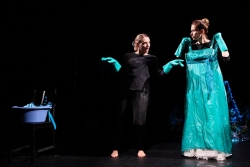
Ophelia. An Object Study ("OAOS") is an exemplary black-box adaptation of Hamlet, adopting the perspective of contemporary values and aesthetics. Olena Romanova, playing Cleaner 1, and Ewa Kaczmarek, playing Cleaner 2, retell the play Hamlet from the innocent perspective of Ophelia, inserting their personal commentaries on the play’s characters and events.
Naturally, both actresses empathise strongly with the only two female characters in Hamlet, Ophelia and Queen Gertrude, and believe they are the victims of the opposite sex’s ambition. Their stance is made explicit in the opening of the performance, where two cleaning ladies arrive to tidy up the mess caused by the last scene in Hamlet. At which Horatio remains the sole survivor to tell the tale, while all other main characters have perished in the dramatic action. When the cleaners are clearing up the blood and the corpses, they moan about men being responsible for murdering one another and stirring up the chaos, but women who are bystanders also have to pay the price. A clever pun. They pay in labour to clear out the wreckage; Ophelia and Gertrude pay with their life. Furthermore, they show distinct attitudes when introducing the play characters and handling their corpses. Most male remains are disposed of coldly like trash, while the female remains are carried with affection and respect.
OAOS reinterprets the story of Hamlet from the viewpoint of women today, yet it is not radically breaking ground. The relationship between Cleaner 1 and Cleaner 2 best illustrates the central tension of the performance. They appear to be close friends with each other, but they have differences in opinions. On one hand, Cleaner 1 has a strong affinity to Ophelia, aligns with contemporary left-wing values and is critical of the patriarchal structure; on the other hand, Cleaner 2 admires Horatio as the extension of Shakespeare, follows traditionalist ideas and embraces the patriarchal narratives. In the part where they stage the story of Hamlet chronologically from Ophelia's point of view, both cleaners add counterpoints and arguments to the events as narrators. Ultimately, the climax of the play is when Cleaner 1 successfully convinces Cleaner 2 to side with her by proving that Cleaner 2's beloved Horatio, more than likely, played a part in Othelia's death. They reach the conclusion that Horatio chooses to be a passive onlooker, permitting Othelia's demise. The show ends with both cleaners reaching a consensus, and together they lay Othelia to rest properly.
The brilliance of the performance is attributed to the director Ewa Kaczmarek's fluid execution of the object theatre. The creative choice of using water and clothing as the core objects not only resolves the limitation of a small theatre production but also becomes the magical spark for multiple scenes. Using a piece of the character's costume to stand for the characters on stage allows the huge production of Hamlet to be performed by two actresses. For example, a glamorous night gown represents Queen Gertrude, a pair of slippers represents the sly Polonius, and a pair of socks represents the minor characters of Rosencrantz and Guildenstern. When playing the scenes in Hamlet, Romanova and Kaczmarek fluidly shift from narrators to the characters simply by wearing the clothing and speaking in the characters' tone and vice versa. This performance style breathes life into the objects and gives the clothing presence. A humorous scene is when Kaczmarek, wearing Polonius slippers in her hands, creates flappy walking noises to pressure Romanova's obedient Ophelia to stop seeing Hamlet. Another memorable scene is the spied conversation between Ophelia and Hamlet, Hamlet's madness is portrayed as bipolar attitudes in Ophelia's eyes through the interchange of different colours of Hamlet's skull t-shirt during their dialogue. Both the flappy noises and the sudden changing colours are clear sensory cues for the audience to experience and to understand the event in Ophelia's subjectivity.
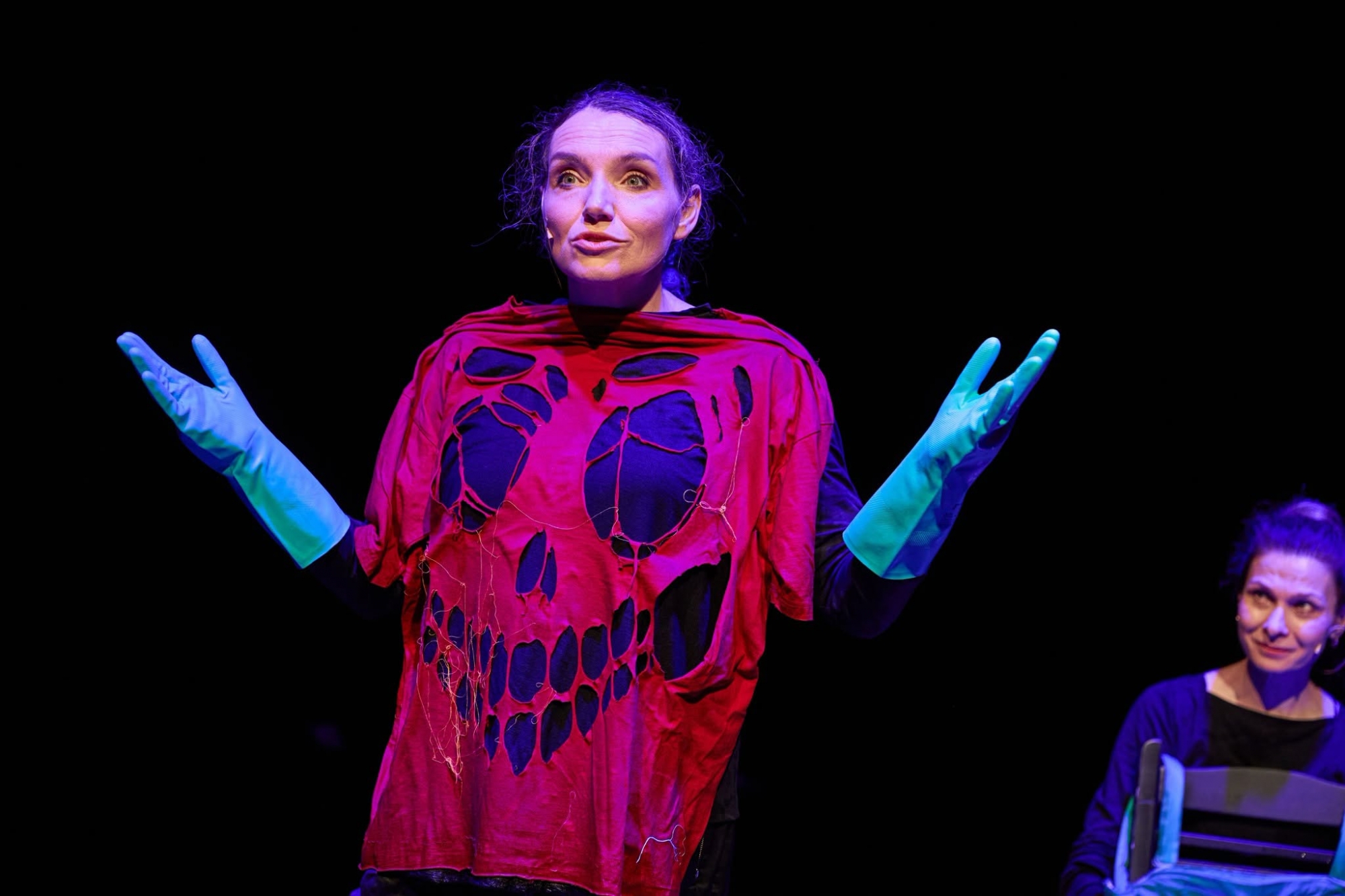
Ophelia. An Object Study by Ewa Kaczmarek
(Photo: Jamie Chan Wai-chi; Photo Courtesy: Tang Shu-wing Theatre Studio)
The witty use of water in OAOS underlines the thesis of the performance. Water is the element that drowns Ophelia and is a substitute for blood in the performance. In the first scene, the drenched clothing of the characters scattered on the wet floor is used to portray the bloody mayhem of Hamlet’s finale, where everyone is dead except Horatio, in an artistic way. Ophelia lying under the fountain water foreshadows the OAOS's propositions that Ophelia is “murdered: by the patriarchy. In the play within a play scene in Hamlet, Kaczmarek projects a clever shadow play showing the king was being murdered through tipping over a filled bottle with the cap removed, resulting in water spilling out until it is dry. The death of Ophelia in OAOS is depicted by Kaczmarek's Gertrude drinking the water dried from the other bottle, which represents both Ophelia and the queen in the play within a play. As Kaczmarek's Cleaner 2 adopts the traditionalist stance, this stage portrayal of Ophelia's death criticises both Gertrude and the audience for contributing to Ophelia's death by following the patriarchal narrative. All in all, OAOSis a coherent, powerful adaptation of Hamlet.
"Marin Sorescu" National Theatre of Craiova's Hamlet ("MSH") is a shortened production in Romanian under strong contemporary directorial ideas. The full, unabridged version is compressed down to approximately two hours long with no intermission. The most striking creative decisions are its two-sided stage blocking, the castings and the wordless scene in the end.
Stage and Costume Designer Nick Ormerod adopts a minimalistic two-sided stage setting and dresses the cast in modern attire of suits and dresses. The stage consists merely of a huge white carpet horizontally placed across, dividing the two facing audience stands, and fourteen hollow black mime boxes spaced along both sides of the carpet. Most scenes of the play are illuminated under indoor white light with little or no stage lighting effects. There are almost no blackouts. The transitions of the scenes are carefully planned and are very smooth, as if one scene flows into the subsequent scene. Combined with the modern attire, it gives the audience a sense that they are watching the events of Hamlet unfolding in real time.
Director Declan Donnellan crafts exceptional blockings that could tell the story on their own. Despite the constraint of a narrow rectangular stage area and minimalist set, the director conveys the power relationship of the characters through accurate placement of performers, levels and movements. The blocking of the opening scene of Hamlet summarises the entire conflict. Hamlet, the only one dressed in black, is sitting in a corner on the stage on a mime box; other characters in silence are standing still in two orderly lines apart welcoming the new King Claudius. Claudius paces freely at the centre among the standing characters, addresses each of them with his speech, displaying his authority and power over his subjects. Hamlet cuts Claudius's speech short with an outburst, taking centre-stage, accusing his mother Gertrude, then Claudius, while eleven other characters all move behind Claudius and Gertrude. All of a sudden, Young Hamlet is confronting all the other characters with his loyal friend Horatio being completely absent in MSH. In other words, Hamlet is depicted going against the entire country. This is exactly the main dramatic action of the play: Hamlet, without an ally, is trying to convince everyone that his father was murdered by Claudius.
Through the placement of characters on either end, Donnellan exposes the internal thoughts of the characters in MSH. The key decisions of Hamlet are two closed options: to avenge, or not to avenge; to be, or not to be. In the "to be or not to be" scene, the Ghost, Hamlet's father, symbolising death, sits on the very left end looking, and Ophelia, symbolising “to be”, sits near the right side of the centre reading. In the famous monologue, Hamlet starts dwelling on the left contemplating death, then moves between the Ghost and Ophelia when struggling to decide, and eventually he walks across Ophelia, choosing life. At that moment, the spied conversation scene between Hamlet and Ophelia begins. Another example is the scene in which Hamlet is deciding whether to murder a praying Claudius. Claudius is kneeling on the right end, and Hamlet is standing behind, lifting a mime box over his head, contemplating murder. Both Claudius and Hamlet are facing the Ghost on the left end. In this composition, if left means virtuous, then the right will mean sinful. At that instant, Hamlet, who is pondering murder, appears to be more sinful than the repentant Claudius.
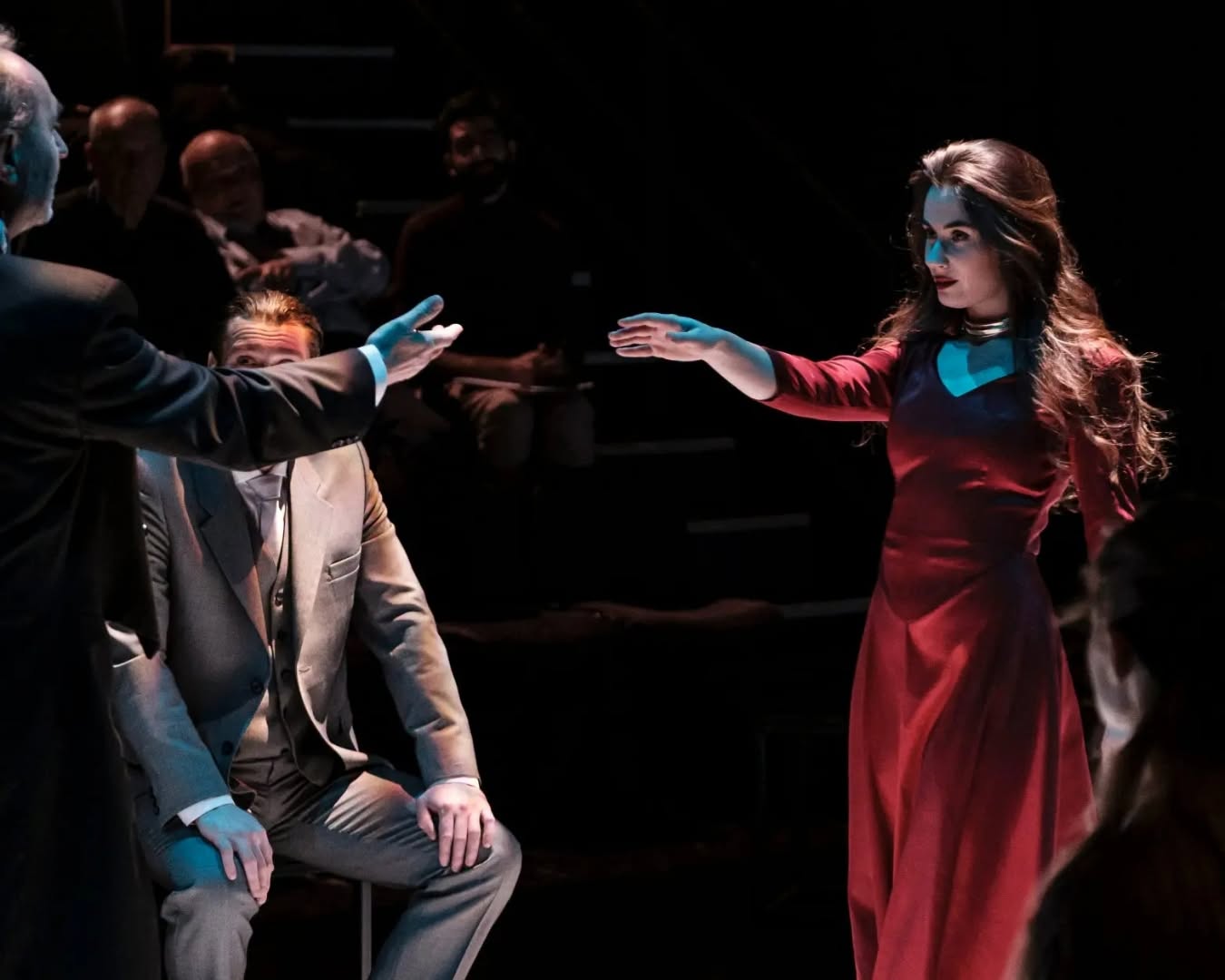
Hamlet by “Marin Sorescu” National Theatre of Craiova
(Photo: Albert Dobrin; Photo Courtesy: Tang Shu-wing Theatre Studio)
At the last third of MSH, the director breaks the “anchorage of meaning” to a particular side and proposes that it is a matter of the character's perspective. Just like the author's left side is the right side for the audience seated facing the author. The turning point is when the dead Polonius, murdered by Hamlet, sits on the right end. Laertes, son of Polonius, mourns his father and demands justice. To Hamlet, justice is on the left side. To Lacerets, justice is on the right side. This put forward a notion questioning whether Hamlet's righteousness is founded on his royal heredity or merely the light painted by the playwright.
Wearing drag as a disguise is a symbol of disingenuity. Vlad Udrescu portrays Hamlet's madness through feminist dressing, such as putting on high heels and red lipstick. On the surface, it can be understood as Hamlet putting on a mask to hide his true intention from others. However, if we take the curious casting choice of Raluca Păun, an actress, playing the role of Polonius into consideration, the director seems to be making a more profound statement through cross gender dressing. Păun 's Polonius is both utterly politically eloquent and thoroughly corrupted. Păun 's portrayal gives the impression that the character will not blink an eye at trading away her daughter Ophelia's happiness in exchange for ascending the political ladder. Being the two drag dressers in the performance, MSH draws attention to the similarities between a mad Hamlet and Polonius.
In Donnellan's MSH, truth is found in the character's action but not in his words. Characters, especially Hamlet, Polonius, Claudius, Rosencrantz and Guildenstern, mainly talk to deceive, to flatter, and even to self-deceive. They babble words, words and words without a pause. Yet those words carry little truth within and are merely essential tools to their personal political agendas. Performing in the foreign language Romanian heightens this feeling and makes it harder for the Hong Kong audience to be emotionally moved by the characters. In the scene when Hamlet first meets the Ghost, Hamlet utters “murder” aloud before the ghost says the word. The idea of foul play is manifested within Hamlet before it is conveyed to him. Words are unable to truthfully depict reality, leaving their actions as the sole clues for the audience to uncover the story's reality. This is the reason why not a single word is spoken since the beginning of the duel between Hamlet and Laertes. Only their actions can lead them to the justice they longed for. When the truth is finally revealed, deceptive words serve no purpose for tying up loose ends and their reunion in heaven. Hence, this explains why there are no dialogues at the end. To sum up, MSH is a finely crafted version of Hamlet under Donnellan's strong directorial vision.
MACBETH Solo, a one-person show directed and performed by Paul Goodwin, is an intense distillation of the original play. The story is told from the first-person point of view of the character Macbeth in sequence, if the brief personifications of the witches in the prologue and the new king Malcolm in the epilogue are discarded. The original Shakespearean language is preserved, but is trimmed down to Macbeth's lines with the occasional weaving in lines from other characters to facilitate the story narration and to intensify Macbeth's internal conflicts. The visual of the performance is frillless. In the entire performance, there are a bare-footed Macbeth in a black T-shirt and trousers, a chair, a thermos bottle and uncomplicated light designs.
The performance resembles an intimate interview session with a restless Macbeth who is suffering from severe insomnia. Under a three-sided stage configuration, Goodwin delivers Macbeth's stream of consciousness and utterances rhythmically at a slightly fast pace continuously with few long pauses. As there is no stage presence of other characters, it appears that Macbeth is either talking to himself or to the audience. The author inclines towards the latter because Goodwill uses deliberate and precise gestures to underline the important symbols, such as pointing to the imaginary blood dripping from his right forearm and wearing an imaginary crown, to the audience. As the events unfold, Goodwill's calm Macbeth becomes more and more agitated and unstable. Thus, the entire performance emerges as a psychologically broken Macbeth, before his final battle with Macduff, reminiscing and retelling his past.
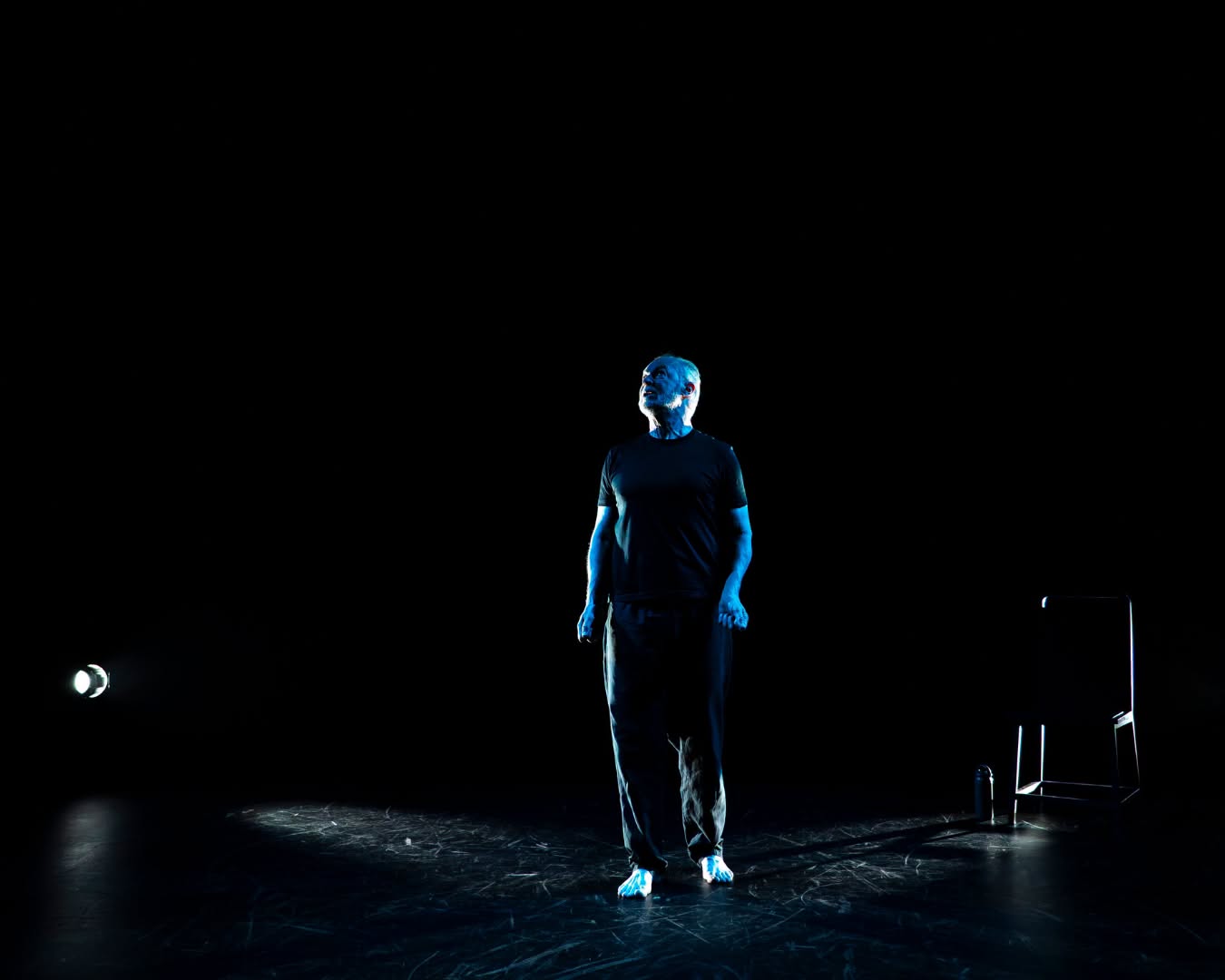
MACBETH Solo by The Shakespeare Edit
(Photo: Fung Wai-sun; Photo Courtesy: Tang Shu-wing Theatre Studio)
MACBETH Solo demands comprehensive knowledge of the story Macbeth from the audience. Since there is an absence of stage presence of other characters, obvious location indicators and iconic action in the first half of the show, the audience who has not learned Macbeth by heart struggles to identify which scene is put on display. The spoken words in an atypical sentence structure are the only hints given to deduce the answer. Not to mention, the scenes change in the blink of an eye. The cue for the transition can be the actor turning around, a shift in the atmospheric soundscape or a sudden change in the stage light colour. Fortunately, in the second half, the utilisation of the empty chair and voice-over to depict Banquo's ghost and the witches as the antagonists to Macbeth enables the audience to grasp the scenario much more easily. The fulfilment of the prophecy that Birnam Wood comes to Dunsinane Hill is cleverly shown on stage through simple stage lights. The Birnam Wood is represented by three green patterned lights casting tree shadows angled away from the centre stage in different directions. Their arrival at Dunsinane is characterised by the green lights one by one sweeping to the centre where Macbeth stands. There are many more such ingenious details in MACBETH Solo for the knowledgeable audience to discover.
Another one-person show, The Rape of Lucrece ("TROL"), performed by Elena Pellone, is a fascinating experimental piece that exhibits the timelessness of Shakespeare's work and the beauty of his language. The text is a non-dramatic poem that narrates with creative license the titled significant historical event that led to the fall of the Roman monarchy and the founding of the Roman Republic, which is the foundation of Western democracy. Pellone makes this obscure poem more accessible to the general public by performing it verbatim on stage. When the audience enters the black box theatre, surrounded by legions of burning white candles, Pellone, dressed in a revealing plain white gown, is sleeping comfortably in a seated leaning position towards the high back of a wooden chair at the centre of the stage. A vivid image captures Lucrece's peaceful moment before Prince Tarquin intrudes with his lustful fire.
Unlike MACBETH Solo, Pellone plays the role of the all-knowing narrator and smoothly embodies the characters in the story. Her delivery of the Shakespearean lines is sublime. It is clear, well-paced and musical, allowing the audience time to comprehend and space to imagine. As if a spell, combining with the natural signalling with her hands, she conjures the characters, the settings and the literary imagery in the minds of the audience. The viewing experience is like listening to a master storyteller narrating an ancient tale at a bonfire.
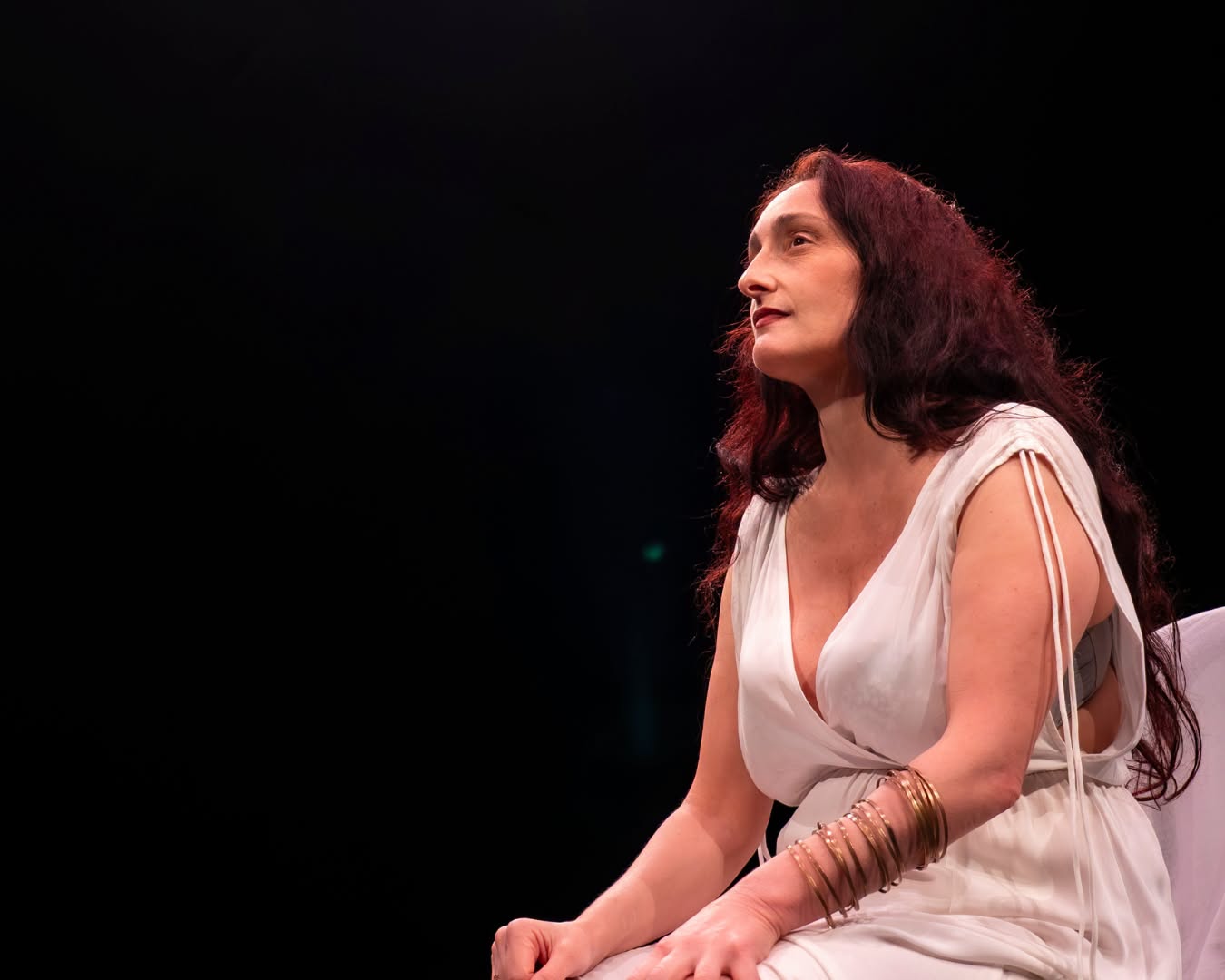
The Rape of Lucrece by Anərkē Shakespeare
(Photo: Fung Wai-sun; Photo Courtesy: Tang Shu-wing Theatre Studio)
Despite Pellone's engaging storytelling, she is unable to overcome the innate flaws of TROL as a theatrical piece. The poem lacks external conflicts and is heavy in elaborated intellectual internal monologue. This is particularly problematic from the beginning to the transgression, which is about a third into the play. Tarquin is arguing with himself whether to commit the despicable act in verse. When he has decided, merely by a threat, he makes Lucrece yield without any resistance. There are no suspensions or obstacles in this part to capture the audience's attention. Fortunately, the aftermath of the crime that focuses on Lucrece naturally sparks interest due to curiosity. Although the rhyming lines remain actionless and fall again into internal debate, Pellone's presence and mannerisms create an entry point for the audience to empathise with Lucrece's trauma. In the last fifth of the performance, when Lucrece exposes Tarquin's violation to her father and her husband, the performance suddenly turns dramatic. This is when Pellone exhibits an excellent range of portraying multiple characters through her voice and body language. For instance, Pellone becomes the character Brutus by a powerful twist of her left arm and by changing to a deeper voice tone to underline the character's gravitas. In spite of Pellone's effort, the problem lies in the non-dramatic text. TROL reveals why adaptations are required when works from other media are transferred to the stage.
It is a rare treat to immerse oneself in the world of Shakespeare and experience the text being interpreted in multiple unique artistic ways in the span of the 2nd Hong Kong International Shakespeare Festival. The author looks forward to the upcoming festival and how artists will make Shakespeare texts relevant for tomorrow's audience.
本網站內一切內容之版權均屬國際演藝評論家協會(香港分會)及原作者所有,未經本會及/或原作者書面同意,不得轉載。