





May 2019
Performing arts are at home in the ephemeral, ever-changing present. Artists have to reinvent themselves constantly, finding relevant forms and concepts for the present. So what use can there be for a heritage policy in such a context? Although this objection can still be heard today, the interest in performing arts heritage from within the artistic community itself has increased significantly over the last decade. Many artists and companies now agree that reflecting about what they want to pass on to other artists, audiences, or future generations is not necessarily at odds with their ambitions as contemporary (avant-garde) performers. Tangible or intangible traces from past performances, events and experiences can inspire new creations, provide a new perspective on one’s own oeuvre, be of invaluable help for education, and even help to reach new audiences through the use of different media and contexts for presentation.
Belgium has a flourishing professional performing arts sector, which is both locally anchored and internationally respected. Artists like Anne Teresa De Keersmaeker and Wim Vandekeybus are known all over the world, and the Belgian scene offers interesting opportunities to young artists. Renowned theatre companies can flourish in the larger cities, but the government’s funding system for the arts also tries to support individual artists and smaller companies in the “fringe” of the system through a variety of funding mechanisms. There is also a rich field of amateur theatre societies and dance schools which have left many traces. These traces are both tangible and intangible, and can be part of or independent from the bodies of practitioners. Performing arts heritage can be a trigger to reflect on the current identity and position of artists or organisations in this field. It helps to question the current trajectory of the performing arts and its organising system in a particular society. A high-quality, innovative and farsighted cultural heritage policy ought to answer the question of what is needed to preserve or safeguard performing arts heritage in a thoughtful and sustainable manner, to pass it on to future generations and to facilitate its use and reuse.
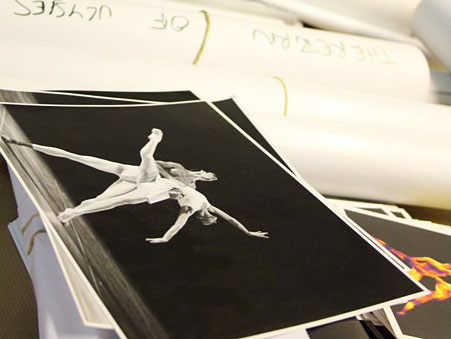
Posters and photographs in the archive at Ballet Vlaanderen/Royal Ballet Flanders
Since a few years, performing arts heritage has been recognised as an important element of cultural heritage in Flanders (the northern, Dutch-speaking part of Belgium). Nevertheless, on a policy level, performing arts collections and archives are not managed centrally and there is no single museum or archive for which it is a core responsibility. To be fair, a number of organisations supporting the professional and the amateur arts used to have a library and documentation centre, and in some cases were and still are actively documenting the field (for instance, the Flanders Arts Institute). Many archival institutions and museums do manage scattered performing arts collections, but there is no central portal to search for them and no coordinated acquisition policy in Flanders. Yet, in order to develop a long-term, sustainable, and integrated policy, performing arts heritage needs to be a priority—if not for a powerful central institution such as a theatre museum or a dance archive, then at least for a coordinated network of dedicated partners. The same is true for intangible heritage. Some performing arts disciplines and related skills, crafts, and techniques are neither directly supported by the government in the current arts funding system, nor taught in an existing educational context. And they cannot be “safeguarded” by presenting them in a museum either. Who will then support these practitioners and communities?
In 2012, the organisation Het Firmament (“The Firmament”) was funded as Centre of expertise for the cultural heritage of the performing arts in Flanders. As of 2019, Het Firmament and Resonant—a similar organisation dedicated to musical heritage—have joined forces as CEMPER - Centre for Music and Performing Arts Heritage. Both organisations had already developed a specific set of services to support heritage institutions as well as professional and amateur artists in their interaction with archives or collections and/or in their need for transmitting intangible heritage. CEMPER will continue to work along these lines. These services are usually offered free of charge, as most of our target groups are funded by the same government and/or work on very limited budgets. Choreographers, actors, musicians, ensembles and companies—both professional and amateur—can approach us with their questions, as can museum staff, local heritage volunteers, teachers, and academics. We use training courses, customised guidance, on-site visits, conferences, online platforms and other ways to share information and build the capacity of our target groups.
The logo of the new organisation CEMPER, Centre for Music and Performing Arts Heritage (Flanders, Belgium)
One of the key strategic ambitions in this approach is, firstly, to bring together the existing expertise of organisations and individuals as much as possible, and secondly, to ensure that it also flows readily to others who need help. While there is an immense amount of expertise—including internationally—not everyone knows where it can be found and who is currently engaged with it. A “service providing” or “supporting” organisation such as CEMPER makes the difference by connecting experts and expertise across the systemic boundaries between the arts and the heritage fields (the latter consisting of institutions such as archives, museums and libraries). We also try to forge links between heritage institutions and individuals involved in education, international organisations and the academic world. CEMPER thus operates as a “broker”, “mediator” and “facilitator”—other terms to describe our approach. Very often, we even need to act as a “translator” or “interpreter” between colloquial, artistic and specialised heritage language and concepts.
As an organisation, we invest in dialogue and consultation with professionals and amateurs from the performing arts field, including students and researchers. The solutions we pursue are based on the specific problems they face. Naturally, one of the reasons why mobilising our network is so important is that we often cannot solve these problems ourselves. We are always dependent on other partners to manage collections, organise performances and exhibitions, publish books or provide funding. This is one of the downsides of merely being a “facilitator”. Yet the advantage of the “networked model” is that it can lead to a coordinated, and therefore hopefully less fragmented, more visible and more sustainable approach to shared needs and issues in different areas. Together, and on the condition that one of them takes the lead, partners can sometimes realise what they cannot do separately. Nevertheless, partnerships are vulnerable and sometimes fall apart when political and budget contexts change. The key aim is, therefore, to structurally “anchor” these partnerships and the resulting projects in the strategic goals of the participating organisations. To ensure this, the responsible politicians and funding bodies have to be convinced of the added value in the long term as well. Artistic, historical or educational long-term projects with an appeal to a wider (culturally interested) audience—but not limited to an ephemeral “event”—might help to ensure this.
The following overview of our strategic goals for the next years will help to understand what our approach means in our daily practice.
1. Mapping, contextualising & developing guidelines for searching
Collections and archives related to the performing arts are scattered among different actors in the arts and heritage fields. CEMPER is actively committed, therefore, to tracing, mapping and adequately describing these archives, collections and items. How can we encourage and inspire curators, artists and researchers to make use of them, if they are nowhere to find? We have made a number of the identified collections visible in the feature section “Heritage in the spotlights” on (the previous version of) our own website. A more structural solution is the description of performing arts archives in the central database of private archives in Flanders, using the international ISAD(G) standard. The inclusion of adequate contextual information adds to the basic description of collections and makes it possible to map the relationships that exist between them, potentially revealing unexpected possibilities. Providing accessible contextual information is also why we supported a number of initiatives related to Wikipedia/Wikimedia-environments and the performing arts in Belgium. Additionally, CEMPER and Flanders Arts Institute are preparing an online portal with guidelines on where to search, both online and offline, for performing arts documentation. To make this really practical, we will integrate a list of model questions and answers. One particular challenge is also how to identify and map the different intangible techniques, approaches and processes of the performing arts, if only to give them visibility for artists and policy makers?
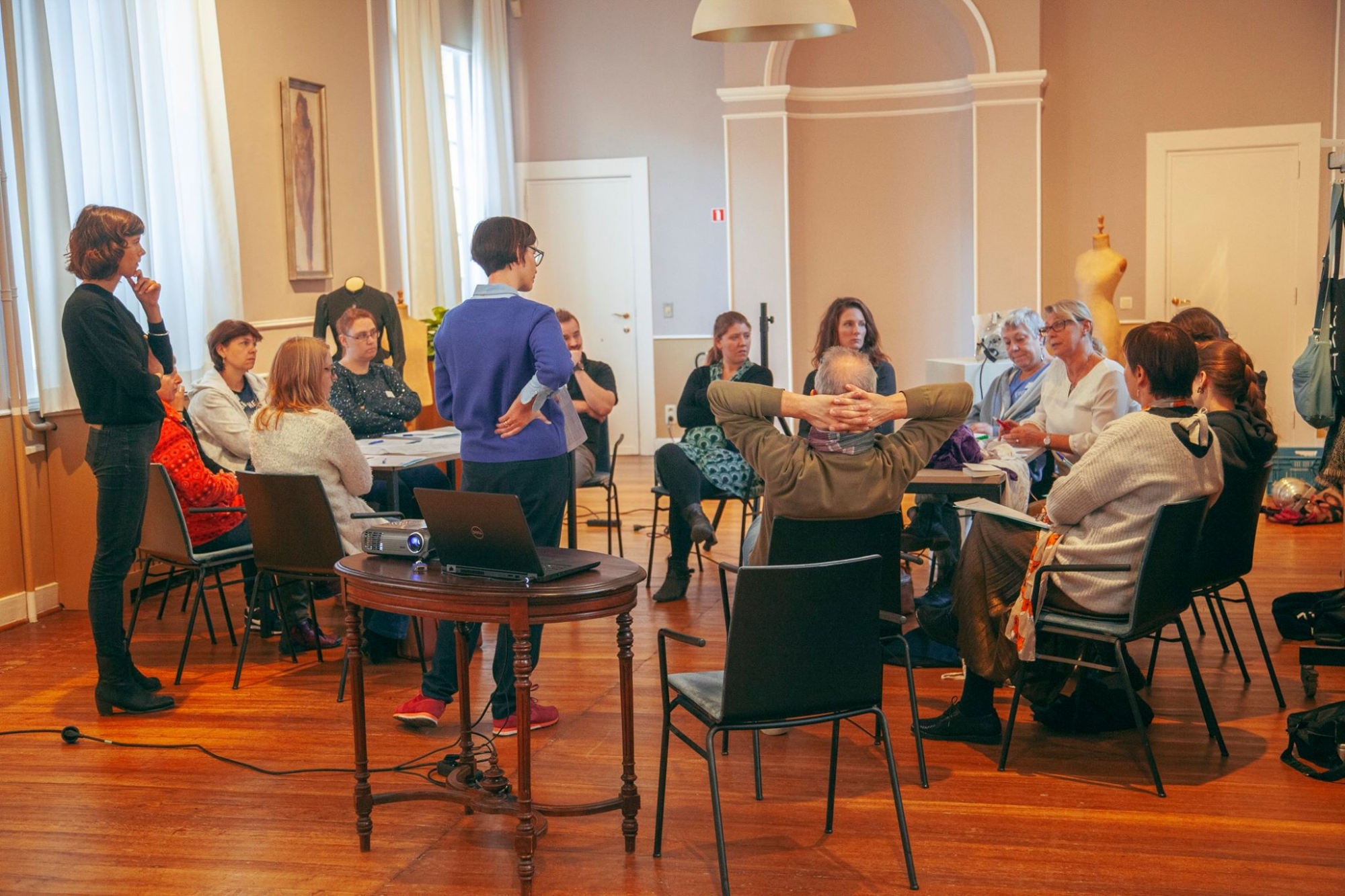
CEMPER staff members frequently give workshops on how to document and care for theatre and dance collections. This workshop was focused on describing and photographing dance costumes.
2. Documenting
Artists are themselves responsible for the traces they leave. Are they happy with the documents in their archives? Or do they want to create additional documentation of their practice? A few performers and dramaturges have asked CEMPER to provide them with a framework on how to approach this challenge. This has resulted in the online platform www.youdoc.be, which is, however, still under construction. Documentation is also a challenging part of different methodologies to safeguard intangible heritage (see below).
3. Valuing heritage & developing a values-based heritage policy
Encouraged by the Flemish Government and inspired by methodologies from The Netherlands, Australia and the UK, CEMPER launched a number of experimental projects on how to assess and document the significance of a collection or of a set of collections (for instance, a collection of theatre puppets, different collections of painted set pieces, different collections of jazz records). We examined their “significance” considering a multiplicity of possible values (such as historical, artistic, scientific, social value, and potential use), discussing them in a participatory way. Also intangible heritage practices can be valued, using a bottom-up approach, by the communities themselves. The combination of a good overview of performing arts collections, archives, and practices (see above), and a way to assess and discuss their significance, can help policy makers to take properly founded decisions when managing, researching and funding heritage. Anticipation is the key: We want to have this knowledge before acute problems force those in charge to make these decisions.
4. Sustainable care for performing arts collections and archives
We welcome all questions about how to preserve (digital or non-digital) collections or archives and how to make them accessible to different audiences. Some target groups will also be referred to the online toolbox www.projecttracks.be (see my next contribution). We will continue our successful formula of “archival assessments”, which brings staff members of a number of performing arts organisations together to collectively assess the strengths and weaknesses of the way their organisational archives are dealt with. We help them in defining the priorities and in reporting about them to their senior management. We also give advice on which archives or museums might be interested in accepting archives or collections that need a new home. Another concern for dance and theatre companies is the management of their audio-visual recordings, and the urgent (!) need of digitisation of their analogue carriers. CEMPER has teamed up with a number of partners to draw up an inventory of these collections. We then formed an alliance with the Flemish Institute for Archiving (VIAA), which the Flemish Government set up in 2012 to realise the digitisation and long-term archiving of Flemish audio-visual heritage and to set up a public platform for its (partial) consultation. By now, VIAA has digitised a large part of this material, which will be made available in due course for educational and research purposes, and, of course, for the companies themselves. It is important to emphasise that the companies remain the legal owners of their audio-visual files, including the management of all the related rights. Digitisation, storage and some aspects of their presentation, however, are realised centrally by VIAA, which results in economies of scale and maximisation of the cost efficiency. We hope to be able to offer a similar service to music organisations in the near future.
5. Safeguarding intangible heritage
CEMPER supports communities—e.g. puppeteers, Bolivian dancers, circus artists, hunting horn players—wanting to safeguard their intangible heritage in Flanders. For that, we develop new methodologies in addition to existing international practices. Many intangible practices and performing arts communities have already registered on the central Flemish platform www.immaterieelerfgoed.be, but we hope to maximise this in the future. CEMPER also assists individuals and communities with the application for the Flemish Inventory or the UNESCO List of Intangible Cultural Heritage, as well as for a new grant provided by the Flemish Government to support the transmission of intangible skills and craftsmanship between a “master” and an “apprentice”.
6. Research
CEMPER is not a research institution, but we want to support and facilitate research (by others) into performing arts history and heritage in a structural way. Therefore, we communicate about researchers (also non-academic), their research, research lacunas and opportunities. Together with the researchers and based on an assessment of their needs, we hope to develop helpful instruments and services (for instance, heuristic guidelines, or an overview of sources related to particular topics).
7. Presenting heritage
CEMPER is often asked for help and advice in the conception and realisation of publications, exhibitions, websites or artistic projects related to performing arts history and heritage. Apart from this, we also communicate about “good practices” on our website.
CEMPER will support anyone who is dealing with these activities, and will sometimes take related initiatives of its own. In a number of these fields, we devised and/or still support a number of online platforms that will be discussed in my next contribution for this month.
本網站內一切內容之版權均屬國際演藝評論家協會(香港分會)及原作者所有,未經本會及/或原作者書面同意,不得轉載。