




 |
The Nature of Why is a stand-up concert by Paraorchestra, the world’s first professional inclusive orchestra, after their debut at the 2012 London Paralympics. This performance connects the music and dance performance with physicist Richard Feynman’s recordings on the nature of magnetic force. Some classical music-goers may prefer traditional composers, but this show offered them a new perspective by blending the curious nature of Richard Feynman.
The packed auditorium buzzed with anticipation - audiences captivated by the dark, warehouse-like venue and vintage light bulbs. Many of them took selfies. The conductor’s energetic introduction, drum sets, and other instruments, along with Feynman’s recordings and the New Music ensemble (one of the professional Hong Kong music ensembles experienced in contemporary settings), eased my doubts about its similarity to another show at New Vision Festival 2018: LightSpace by Michael Hulls. That show was in the same auditorium, with filament light bulbs. The audience could take pictures before the show.
This performance elegantly balanced the challenges and aesthetics of inclusive arts. It not just focused on facilities for different needs but on intellectually curating a show that resonated with diverse audiences, regardless of education, life status, or disability. Instead of only creating a platform for all through non-verbal music and dance, the show fostered engagement and comfort. Charles Hazlewood, Caroline Bowditch, and Will Gregory showed how inclusive arts can reshape space through music and dance, building a utopia where people of varying abilities enjoy a happy, egalitarian experience.
Beyond dancing with people with different abilities with live music
In this one-hour standing concert, the dynamics and rhythm were essential to help the audience forget their need for a chair. The recordings of Richard Feynman provided an interlude between each movement. This blending of music, dance, and Feynman’s questions about seeking the truth elevated the performance from an immersive concert to a truly inclusive experience, inviting us all to wonder about the whys and hows of differences among people. Feynman's reflections on magnetic force, at first glance, might seem unrelated, but they subtly shaped the experience by presenting the invisible but powerful fields that influence movement and connection, both in the physical world and within our shifting audience. His sharing reminded us to view the performance space as a living field, full of individual trajectories drawn together or apart by unseen causes. Watching the audience ebb and flow around the dancers, it became clear how Feynman's scientific perspective encouraged a wider reflection: just as in physics, the reasons for our movements and responses may not always be obvious, yet they have depth. Feynman also reminded us that people with different backgrounds might see and interpret the same thing quite differently, a parallel to the diverse ways audiences engaged with the piece. This gentle reminder on truth-seeking and acceptance of uncertainty reassured both the sceptical and the open-minded in the crowd, allowing everyone to settle into observation without needing all the answers. Though Feynman’s answer might not directly relate to inclusive arts, the idea of putting yourself in others' shoes aligns with the core idea of inclusion. And for those unfamiliar with Feynman's specific language, Gregory’s music and Bowditch’s choreography still offered a visceral and collective rhythm to immerse in.
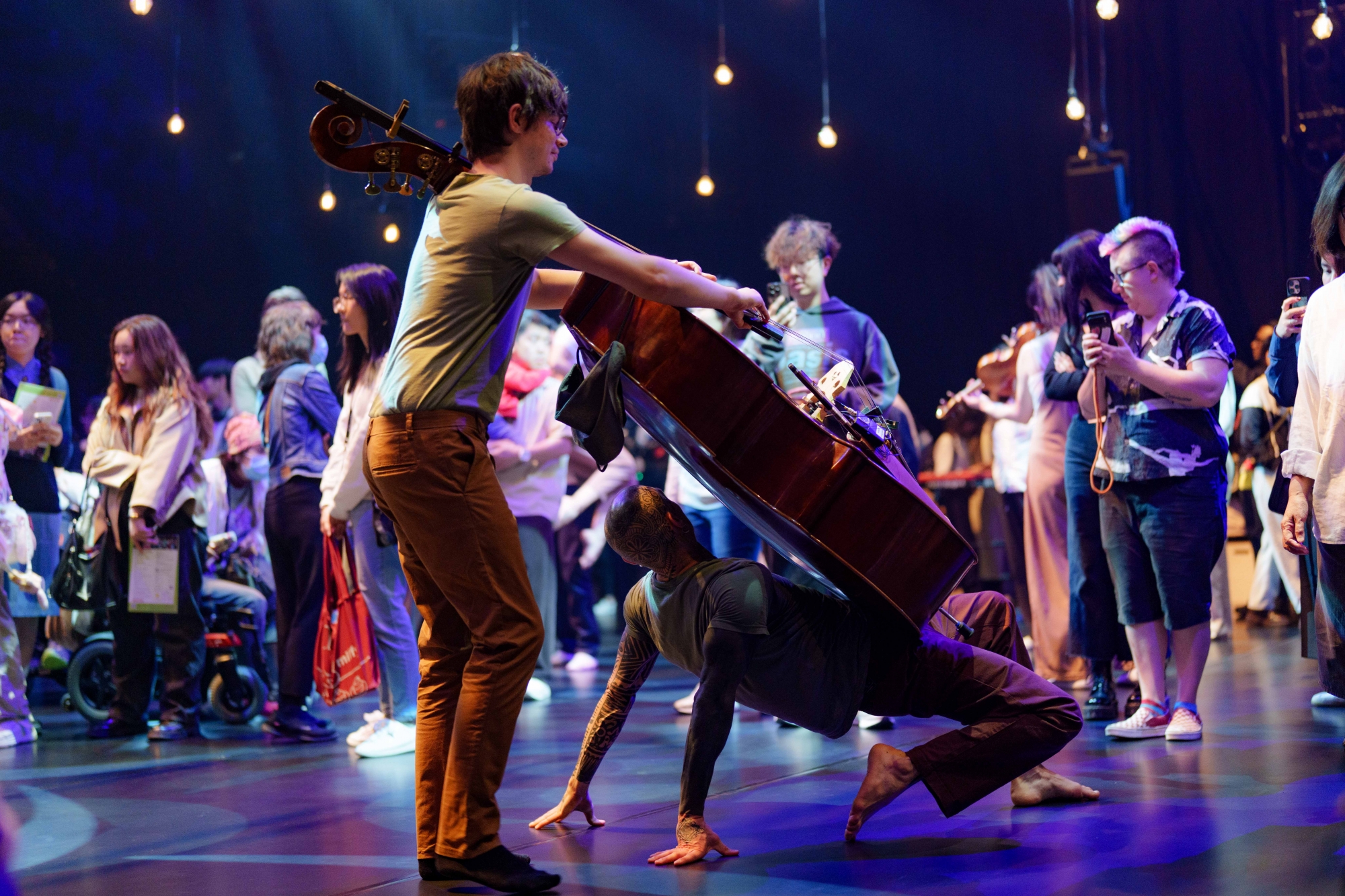
The performance combines music and dance
(provided by No Limits)
Contemporary music and dance symbolised as a driving force of people with different abilities in society
Music and dance are the common languages of people from different cultures and abilities. As a music learner who had a visually impaired pianist as my piano tutor before, I found that music allowed us to communicate much better by recognising his talents. In this performance, the sweat of these artists showed they were working hard to extend their performance space, breaking amid the crowd as perpetual forces in different movements to showcase their talents to the audience. Audience members, mostly non-disabled, seemed like a wall to artists with different abilities when they were busy taking photos. For other people with different abilities, the Hong Kong sign language interpretation and audio description were available. Luckily, the momentum sustained by dotted rhythm and semiquavers, as well as the spectacles created by the dancers with different abilities, kept audiences moving, fearing they might miss moments to capture on social media or for memory. Though there were some seats and people could walk freely on the stage, it was challenging to maintain the anticipation and engage the audience. However, the variety of lighting, dancing, and the momentum of the music weaved like a magician who kept pulling rabbits out of his magic hat. This was similar to disabled artists in real life: they continued to perform in society, but the wall did not fall.
Sometimes, these artists invited the crowd to join their performances. These interactions could bring more enjoyment to others. At that moment, the wall collapsed, the boundary blurred, and the driving force became stronger. There was a scene in which all the dancers and musicians with different abilities lined up in the centre of the stage, followed by a line of audience members. It was an astonishing scene, showing the united spirit of people with different abilities here, accompanied by solemn music. The joy of inclusive arts emerged here, achieved through the determination of artists with different abilities to use their talents. Indeed, the joy of the inclusive arts came not only from the performances of artists with different abilities, but also from how people from different backgrounds collaborated on the performances, recognising the disabled artists’ talents and contributions. The celebration in the last movement, of course, with the flying of semiquavers from xylophones, melodic lines from clarinets and violins, heightens the joy of this utopia, though it may not be able to sustain outside the theatre.
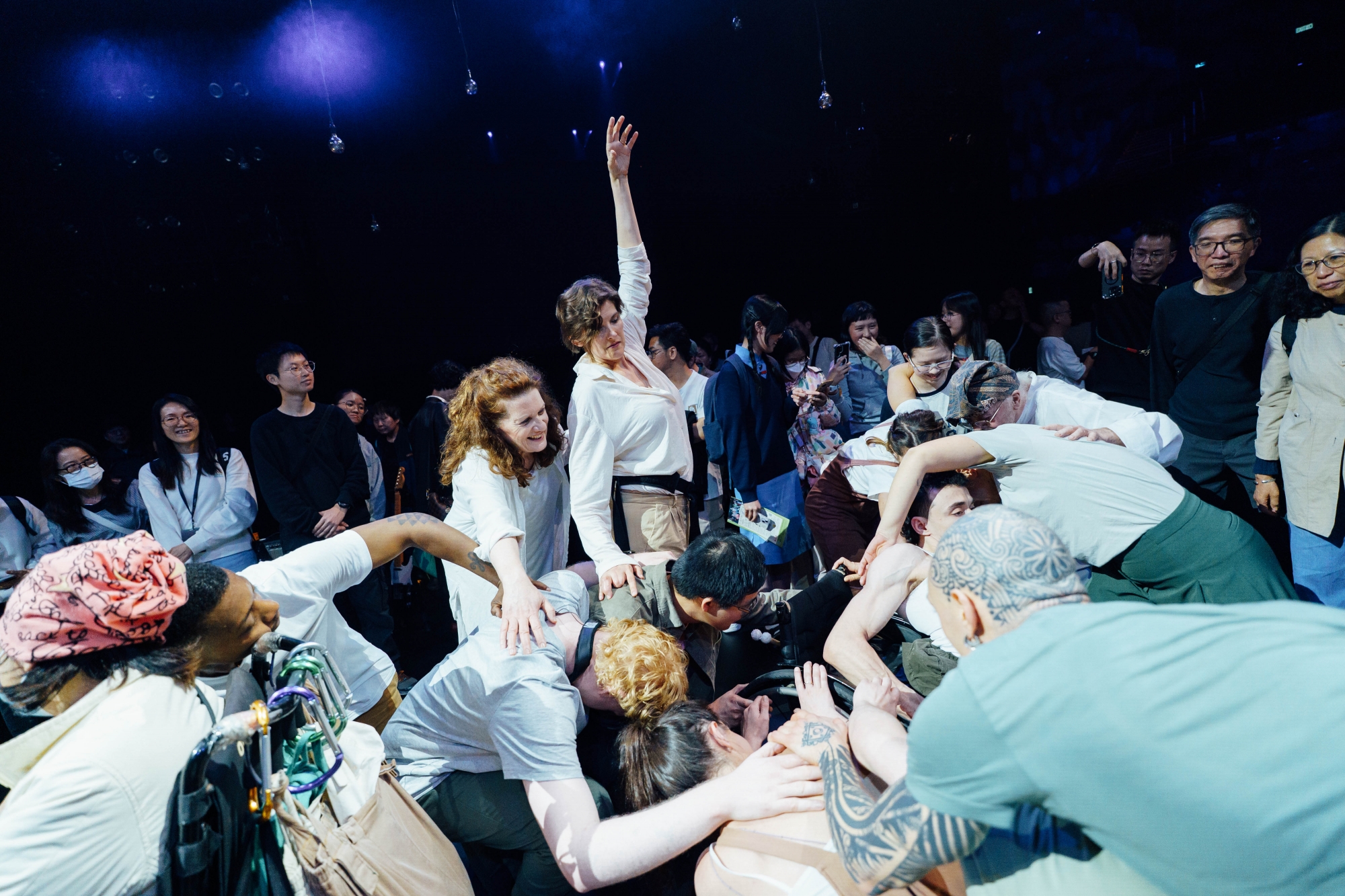
Audience are free to stand anywhere in the venue, as if they were part of the performance
(provided by No Limits)
Inclusive Arts beyond putting people with different abilities together
Providing a platform that allows people with varying abilities to share their creative talents may be a cliché in inclusive arts. The Nature of Why demonstrated another dimension of inclusive arts to the Hong Kong audience, showing that facilitating collaborations among artists with different abilities is only the first step. The artistic vision that truly allows artists and audiences with different backgrounds to engage, interact and share matters. It was not simply about placing artists, including disabled artists, on the same stage or providing extensive inclusive support for audiences. The artistic choice can be traced back to the Paraorchestra's rehearsals. Hazlewood shared that he would ask his artists with disabilities what kind of support they need to express their creative musings in the meet-the-artist section. This was very impressive to an amateur member of a string ensemble like me. In traditional ensemble or orchestra training, members must be disciplined and adhere to the rules and progress during rehearsals. That is necessary for instrumentalists to be on the same page; otherwise, the performance will fall apart. However, what Hazlewood did here broke the standard protocols for both the operation of an ensemble and for the supports and inclusive arts. As an arts administrator who has worked in inclusive arts before, I understand that these tailor-made supports often create huge extra workloads and require significant resources. However, The Nature of Why proudly demonstrated that a moment of realisation of the utopia without boundaries is worth for that.
Afterword - A note about the terminology:
I try to work with “people/artists with different abilities” to address “disabled people and artists” here. I know this may draw some confusion here. Hazlewood mentioned that he doesn’t like the term “people with disabilities”. I agreed with the notion, and his ensemble members are talented. To respect these talented artists, I try my best to use “people with different abilities” rather than “people with disabilities”, though I occasionally cannot maintain consistency to minimise confusion.
本網站內一切內容之版權均屬國際演藝評論家協會(香港分會)及原作者所有,未經本會及/或原作者書面同意,不得轉載。